
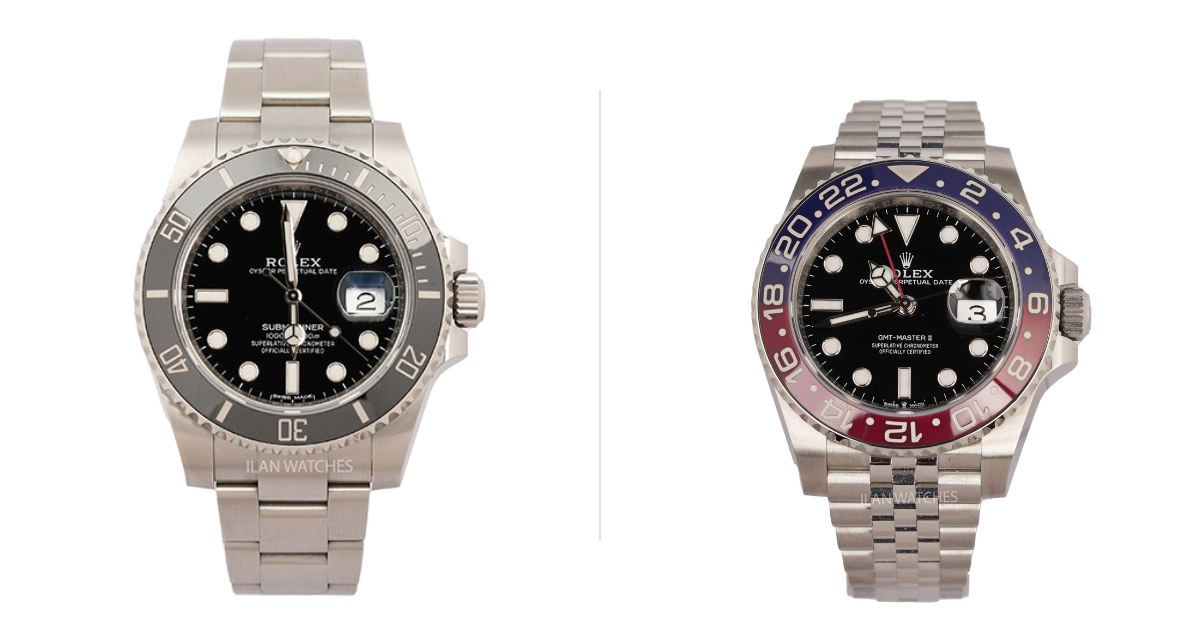
They look alike at first glance: steel case, black dial, ceramic bezel, Oyster bracelet. But the Rolex Submariner and the GMT-Master II were built for two very different jobs. Here is how they differ, and which one fits the way you live.
At our showroom in the Dubai Gold District, no question comes up more often than this one: “Should I buy a Submariner or a GMT-Master II?” Both are icons, both are made for everyday wear, and both are among the most sought-after sports watches Rolex makes. The right choice depends less on which watch is “better” and more on what you want it to do for you.
The short answer
- Choose the Submariner if you want the classic tool watch: bold, sporty, water-resistant to 300 metres, with or without a date.
- Choose the GMT-Master II if you travel or work with people in other time zones, and you like colourful bezels and the option of a Jubilee bracelet.
Submariner vs GMT-Master II at a Glance
| Submariner | GMT-Master II | |
|---|---|---|
| Introduced | 1953 | 1955 (GMT-Master), 1983 (GMT-Master II) |
| Built for | Divers | Pilots and travellers |
| Case size (current models) | 41 mm | 40 mm |
| Water resistance | 300 m (Triplock crown) | 100 m (Twinlock crown) |
| Bezel | 60-minute, turns one way only | 24-hour, two colours, turns both ways |
| Extra function | Measures elapsed time | Shows a second (and third) time zone |
| Movement (current models) | Calibre 3230 (no date) or 3235 (date), about 70 hours power reserve | Calibre 3285, about 70 hours power reserve |
| Date | With or without | Always with date |
| Bracelet | Oyster with Glidelock extension | Oyster or Jubilee with Easylink extension |
| Well-known nicknames | Hulk, Starbucks, Bluesy | Pepsi, Batman, Batgirl, Root Beer, Sprite |
Two Watches, Two Missions: A Short History
The Submariner arrived in 1953, when scuba diving was becoming popular and divers needed a reliable way to know how long they had been underwater. Their air supply depended on it. The rotating bezel was the answer: line up the triangle with the minute hand before the dive, and the elapsed time can be read at a glance.
The GMT-Master followed in 1955, developed with Pan American World Airways for pilots on the new long-haul jet routes. They needed to read home time and local time at once. In 1983 the GMT-Master II added an hour hand that can be set independently, which made changing time zones much easier.
What Each Watch Does in Everyday Life
The Submariner: the timer on your wrist
Few owners dive to 300 metres, but the bezel is useful every day: timing a parking meter, a meeting, a workout or a steak on the grill. The bezel turns only anticlockwise, so if it is knocked by accident it can only show more elapsed time, never less. That is the safe direction for a diver, and a satisfying click for everyone else.
The GMT-Master II: two or three time zones at once
The GMT-Master II has an extra 24-hour hand that points to the 24-hour bezel. Set it to the time back home, and you always know whether it is a good moment to call family or the office. When you land in another city, you only move the hour hand in one-hour steps with the crown; the minutes and seconds keep running and the date follows automatically. Turn the bezel as well, and you can read a third time zone.
For many of our clients in Dubai this is a real, daily advantage: business partners in Europe, family in Asia, flights through several time zones. The two-colour bezel also helps to tell day hours from night hours in the second time zone.
How They Wear on the Wrist
On paper the two watches are almost the same size. In practice the current Submariner, at 41 mm with broader lugs, has a slightly bolder, sportier presence. The 40 mm GMT-Master II feels a little more refined, especially on the five-piece Jubilee bracelet, which dresses it up enough to wear with a suit.
Both bracelets can be adjusted without tools: the Submariner’s Glidelock by up to about 20 mm (designed to fit over a wetsuit), the GMT-Master II’s Easylink by about 5 mm. In the Dubai summer, when wrists swell a little in the heat, both systems are appreciated.
Water, Sand and Summer: Which Suits Dubai Better?
Both are fully suitable for swimming, the beach and the pool. The GMT-Master II’s 100 metres of water resistance is more than enough for everyday water sports; the Submariner’s 300 metres is there if you dive seriously. For either watch, make sure the crown is screwed down before you swim, and rinse the watch with fresh water after the sea.
Styles and Nicknames
The Submariner is known for its restraint: most versions have a black dial and black bezel, with or without a date. The green-bezel “Starbucks”, the older all-green “Hulk” and the two-tone blue “Bluesy” are the best-known exceptions, alongside full-gold versions.
The GMT-Master II is where Rolex plays with colour: blue and red “Pepsi”, blue and black “Batman” (called “Batgirl” on the Jubilee bracelet), brown and black “Root Beer” in Rolesor or gold, and the left-handed green and black “Sprite”. If you enjoy a watch with personality, the GMT offers more choice.
Price and Value on the Pre-Owned Market
Both models are among the most liquid watches in the world, which means they are easy to buy and easy to sell later. On the pre-owned market, steel GMT-Master II models, especially the Pepsi, usually cost more than a steel Submariner. The no-date Submariner is often the most accessible way into Rolex’s professional sports watches.
For both, the same factors decide the price: a full set with box, papers and warranty card, an unpolished case, the year, and the service history. You can see our current prices on the Submariner and GMT-Master II pages.
What to Check Before You Buy
- Box, papers and warranty date – a full set adds value and shows when the watch was sold.
- Case and bracelet – sharp case edges and a tight bracelet are good signs; heavy polishing reduces value.
- Bezel action – the Submariner bezel should click firmly in one direction, the GMT bezel in both.
- GMT function – on the GMT-Master II, check that the hour hand jumps cleanly and the date follows it.
- Service history – service papers from Rolex or a recognised watchmaker give extra confidence.
Every watch at Ilan Watches is inspected by our specialists before it is offered. If you are new to buying pre-owned, our guide for first-time Rolex buyers explains the basics.
Frequently Asked Questions
Which is more comfortable, the Submariner or the GMT-Master II?
Most people find the GMT-Master II slightly more comfortable, especially on the Jubilee bracelet, because it is 40 mm and the bracelet is more flexible. The difference is small, which is why we recommend trying both on.
Can I swim with a GMT-Master II?
Yes. With 100 metres of water resistance and a screw-down crown it is suitable for swimming and snorkelling. For scuba diving the Submariner is the better tool.
Can I compare both watches in your showroom?
Yes. You are welcome to visit us at Hind Plaza in the Dubai Gold District, try on a Submariner and a GMT-Master II side by side and talk it through with our specialists over a coffee.
Can I trade in my Submariner for a GMT-Master II, or the other way round?
Yes. We gladly take watches in part exchange. You usually receive an offer within 60 minutes. More about selling your Rolex.
Still undecided?
See the watches we have in stock right now: Rolex Submariner in Dubai and Rolex GMT-Master II in Dubai. Or visit our showroom and let the watches decide for you.